Don’t Ask for Whom the Trekking Pole Clicks


Image

The Appalachian Trail in the central region is a lot quieter now.  The northbound (NOBO) bubbles are long gone.  Students are returning to school.  And the southbounders (SOBO) are still many miles to the north.  The trekking poles are quiet.

I took a long walk along the AT Friday NOBO from the Compton Gap parking lot in Shenandoah National Park.  It was a chance to test some gear and carry a full winter weight pack as a prelude to the Hoodlum’s monthly trail maintenance Saturday.

Wouldn’t you know it.  I started breaking spider webs right from the get go.  There aren’t too many things in this world that I actually hate, but spider webs are on the list.

Walk through a spider web and it sticks to your hair, glasses, face or arms in the most inconvenient and annoying way possible.  You almost never see ‘em comin’ either.

Then I thought about it.  If the trail was heavily draped in spider webs, that meant nobody had passed by in quite awhile.  Me and the critters had the woods to ourselves.  That’s pure joy.

The day was especially perfect.  Just warm enough and sunny with low humidity.   Then bingo!

I hadn’t yet schlepped a mile when a bear cub trundled across the trail not more than 50 feet ahead of me.  I think it may have been the tail end Charlie because I never did see the momma or a sibling, but I sure was lookin’ for all the obvious reasons. 

Later I saw a huge doe that was big enough to remind me of an elk.  At first I thought she was a buck, but they’re sprouting horns now, so she was just big.

Within a short time I cruised by the Tom Floyd shelter to read the register and snack.  I was greeted by a friendly toad, and best of all, lucky enough to find amusing entries from thru hikers whose blogs I’ve been following.  Some of the handwriting didn’t seem to match their personalities.  That was enough to make the day by itself.

Near the end of the return trip, a couple of bard owls serenaded me with their hooting – the decibel level can drown out a heavy metal rock band. I camped at the Indian Run maintenance hut with a few of my Hoodlum crewmates.  The owls played their rowdy concert all night long.  We loved it.

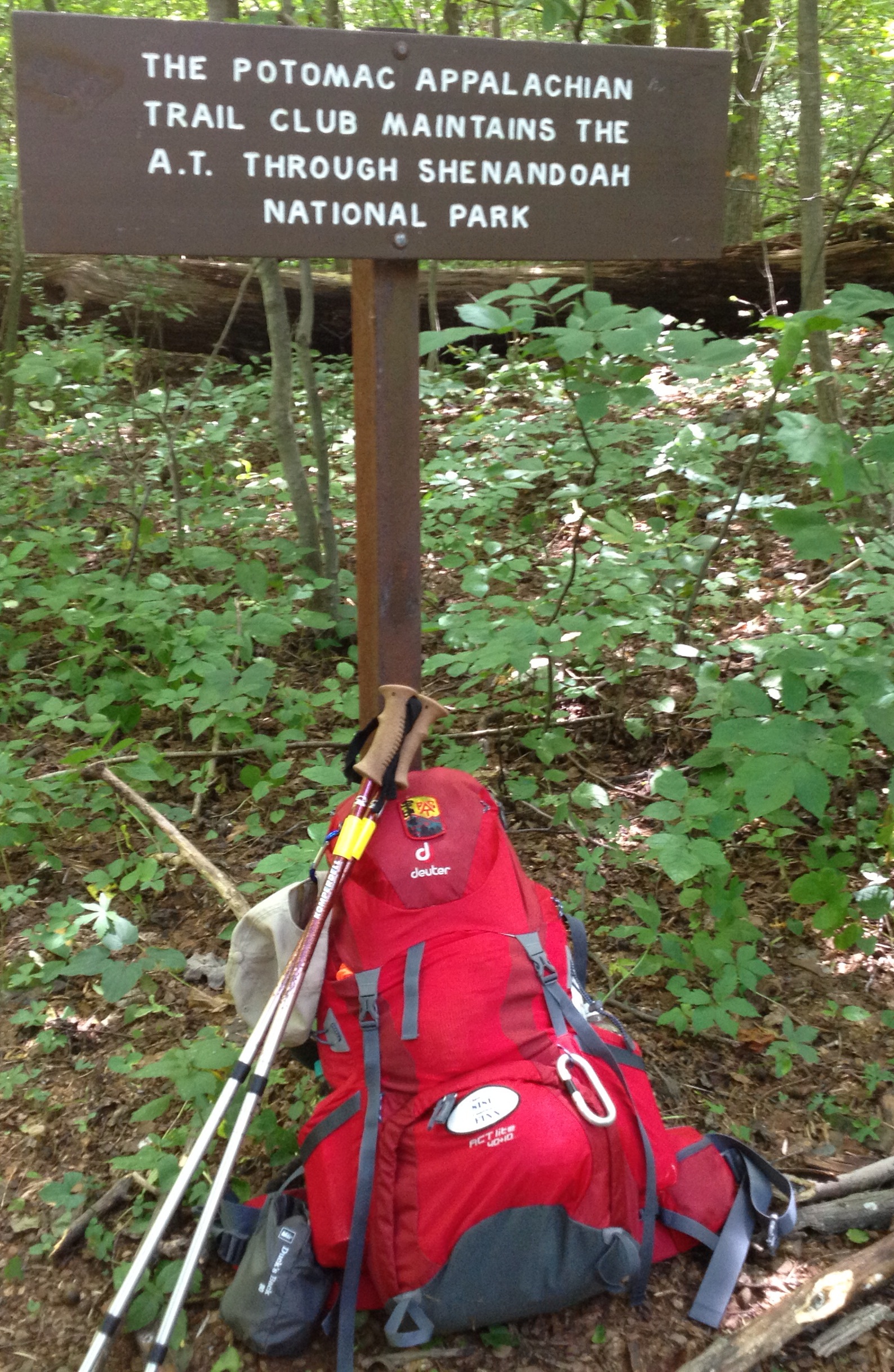
One gear item I was testing was my new (and first ever) set of trekking poles. 

Poles first began to appear back in the days when getting home to hike in the Colorado Rockies was regular fare.  They were seen most often in the hands of clueless tenderfeet.  These dude ranch types always appeared to have been outfitted by Abercrombie and Fitch.  This was back in the days when the store equipped great white hunter wanna bees headed out on city park safaris.

We (then) studly types thought they were pretty dorky.  Not for us.  Moreover they were a European invention where the trails are very unlike most of ours here in the U S of A.  So, in spite of solid recommendations that I try them, I never seriously considered acquiring poles.

Jump ahead to now, and trekking poles have almost become prosthetic aids for hikers.  Everybody’s leanin’ on ‘em.

Honestly, I was surprised.  The test didn’t go well.  As a cross country skier, I expected far better results.

The good news is that poles do provide thrust and tend to slow me down.  I desperately need slowing down.  Their use may be worth that much alone.

The bad news is that on ugly rocks and rough terrain, I kept much better balance without them – a key point when remembering how damaging and frequent falls tend to be.

The AT is mostly down hill from Compton Gap to Virginia highway 522.  The opposite is true for the return trip.  Just after Tom Floyd, the trail gets steep and rocky for a good stretch. 

From my point of view, the poles were useless in either direction in rough terrain.   I actually tripped on one pole trying to negotiate some large rocks, but enjoyed a fortunate outcome.

I didn’t like the tick, click, tick noise they make either.  The racket makes sneaking up on wildlife especially challenging.

Not going to toss ‘em.  Not gonna do it – yet. 

On September 24th my first long shakedown hike will be the 160 miles from Waynesboro, VA to Harpers Ferry, WV.  The trail is well maintained over that course by my PATC compadres. 

If the sticks haven’t won me over by the time I reach the Appalachian Trail Conservancy GHQ, they get aced off the gear list.  If that’s the case, I’ll have to find a new handy spot to stash my bright yellow duct tape.  Damn!

The trekking poles may click the entire length of the Appalachian Trail, but probably not for me.  Like my mom used to say, “Just because everyone else is doing it, doesn’t mean you have to. “  Could be that I’m just incorrigible.  Time will tell.

Image

A Hoodlum trail crew on the march.

Say cheese!

Image

Everybody wants to make National Geographic quality photographs to document their hike on the Appalachian Trail.  Well, maybe most would just settle for some nice snaps of the folks and places that will help keep cherished memories alive long after the trail is done. 

Fact is that with a little luck related to available light, chance timing and the right clouds showing up over a placid pond …and you never know…  You certainly don’t need “professional” photographic equipment to make really good pictures.

Big boy camera gear is large, expensive and technically complicated.  Visualize those sideline photographers at sporting events with their howitzer-length lenses.  Besides, you’d almost need a caddy to drag a camera bag that size up and down the mountains.  The advanced amateur versions of these cameras and lenses produce fantastic photos, but still they are relatively expensive, bulky and heavy. 

Modern professional photography equipment is feather light compared to cameras back in the day. Here’s where I’m going to date myself.  I used to lug a Nikon FTN with a couple of lenses, filter stack, 2x tele extender and a dozen rolls of Kodachrome.  The weight was roughly the equivalent of three bricks.  The cube (amount of occupied space in my pack) was even more than that. 

When technology advanced to the Olympus OM-1 miniaturized 35mm SLR, I thought I’d died and gone to heaven.  This leap forward reduced the weight by about two bricks and the cube by about half.  The downside was that those chunks of metal and glass still weighed a lot.  You always had to worry about running out of film.

Then came digital photography with cigarette pack-sized cameras.  The early cameras by Nikon and Sony took decent photos.  Now the options have expanded enormously, and the photographic quality exponentially, as sensors and chips have improved.

Good light-weight camera options are plentiful.  I know at least two video bloggers in the class of 13 who rely on their GoPro rigs. 

GoPros are the cameras that capture the helmet cam dare devil shots you see on TV. These small water and shock proof hummers mount on trekking poles, chest straps, helmets, snow boards, etc.  You do need WIFI to transfer their photos to your Drop Box, Flickr , Smug Mug or one of the other  web based photo sharing/scrapbook sites.

Plenty of other hikers are carrying small cameras by Lumix, Nikon, Sony and others. 

The vast majority seems to be using the camera built into their phone.  Unless you’re using expensive cameras, all the others will have technical trade-offs.  iPhones, for example, have difficulty handling high contrast lighting situations that the Photo Shop app can’t always fix.

For a good test of two cameras check out “Man Cub and Kit Fox Thru-Hike the Appalachian Trail 2012” on You Tube.  https://www.youtube.com/watch?v=5Tpvzsq2VAg 

The first half of this charming video was shot with an iPhone; the second with a GoPro.  With the exception of the underwater scenes, obviously shot with the waterproof GoPro, it’s hard to tell from the video which camera is which.  It ends with a special treat.  If you haven’t seen it, look for the marriage proposal atop Mt. Katahdin. 

The majority of hikers I’ve encountered who are blogging from the trail are using a smart phone as their primary camera.  It’s just easier to post directly to Trail Journals, BlogSpot, WordPress, Facebook and Twitter.  One sent her GoPro home.  She didn’t need it or its weight. 

Using your smart phone camera offers the Swiss Army knife advantage – one tool that can do many things.  With apps like Photo Shop and iMovie, a smart phone can produce amazing work.

The smartphone story only gets better.  The photographically savvy will want camera lenses. 

Never fear, lenses are here.  The website www.photojojo.com sells an array of equipment, and lenses that attach magnetically to any smartphone.  I have several, ranging from fisheye to 2x telephoto and they do work.  I also found an 8x telephoto that screws onto a threaded phone case that comes with it.  It does not interfere with the other lenses. 

What’s the secret to great photos?  I was fortunate enough to attend a lecture once at the National Geographic Society in Washington by one of the best wilderness photographers who ever lived.  That evening Galen Rowell’s presentation was entitled “The Edge of Light.”  Unfortunately, he met an early demise. 

Google Galen Rowell and check out his work.  You might not be able to duplicate it with a smart phone, but judging by some of the Appalachian Trail photos on TJ this year, you can get pretty close.