Close Bear Encounters of the Third Kind

Image

Bear busted for shopping in store at Shenandoah National Park’s Skyland Resort.  He was a nice guy!

Psst!  Hey you…  Yah, you.  Wanna lose weight?  You do.  Guess what?  Hike for 13 days and 160 miles straight through on the AT without a zero and eat only what’s in your pack and YOU too can lose a pound per day.  I did.  Betcha!  One more hike like this and I might be willing to take my shirt off at the beach.

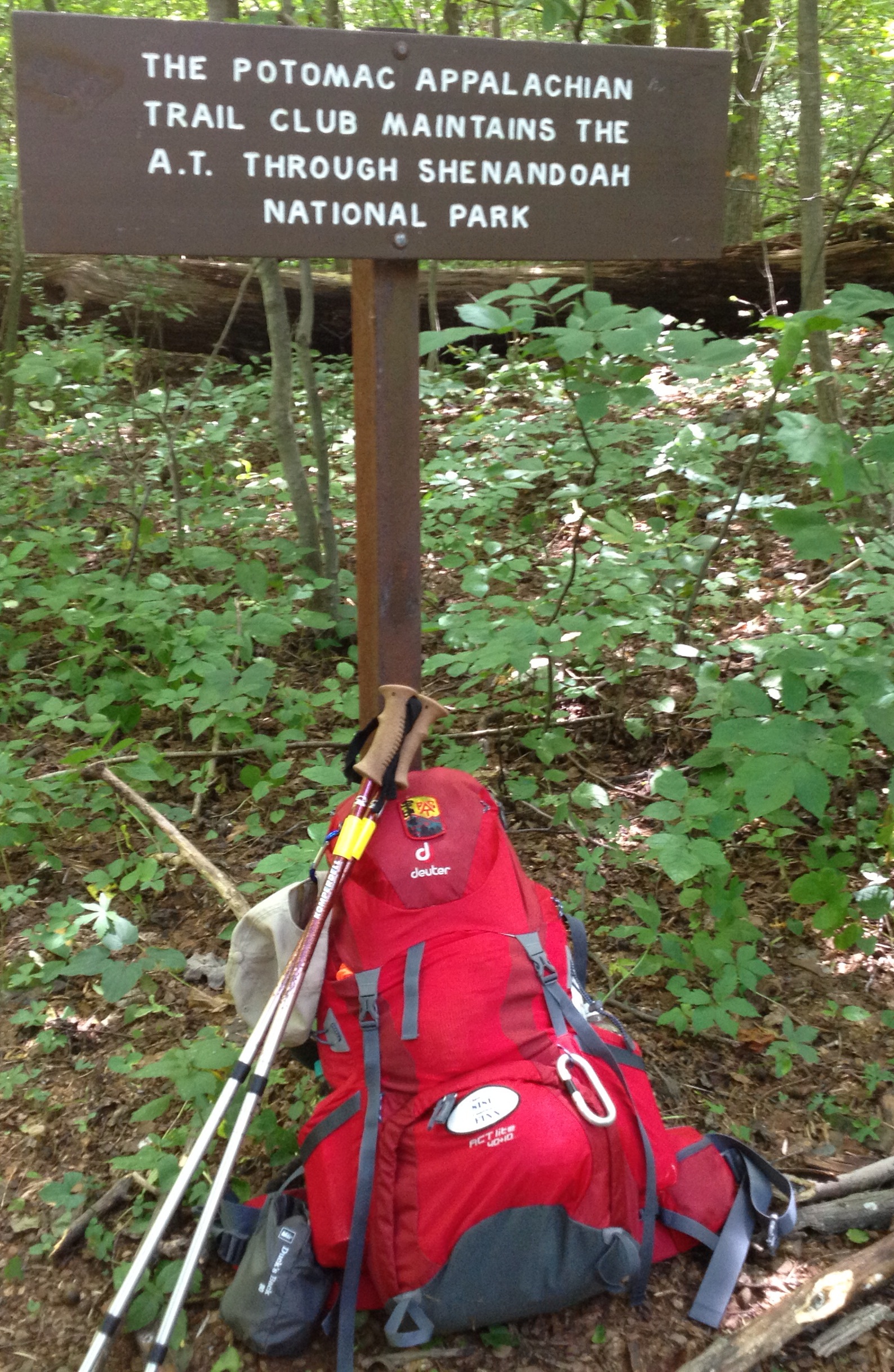
My first training hike is in the books.  Sept. 24th was day one.  I launched at 10:08 a.m. from Rockfish Gap, Va.  It was 55*F.  At 10:12 I saw three bears before I could even get off the road and into the park!  An auspicious beginning if ever there was.

By the time they get this far, 858 miles into their hike, most thru hikers can knock out the distance from Waynesboro, Va. to Harpers Ferry in about 10 – 11 days.  Since this was a test of my injured right foot, my gear, food, and much more, my pace was deliberately slower.

The first day was seven miles to the Calf Mountain shelter.  Most thru hikers would want to bang out more miles, but maybe not the 20 miles to the next shelter at Blackrock.  For those wanting to do more than seven, but less than 20, I counted 14 excellent stealth camping sites scattered between Calf Mountain and Blackrock.  The only caution is that  water is available only at the shelters.  Tank up at Calf Mountain and you’re good to go.

I set the first day deliberately short followed by two 13s in a row.  The schedule next called for rest following an eight mile NERO.  I reached my destination just after noon and cooled my heels until some great guys showed up to spend the evening.  Following that, the days averaged around 12 until I got word that the remnants of a tropical storm would clobber the trail on Monday Oct. 7.  Not wanting to ride out a tornado watch and a deluge in some shelter, I hiked three 15s and a 20 in order to finish a day earlier than planned.  Two weeks without rain – priceless!  Pushing that hard – ouch!!

My initial pack weight was very heavy on purpose. For example, I carried all the food and supplies needed for a full fortnight. I also lugged my full winter kit since that’s the heaviest weight scenario.  Other small things added up such as packing a full bottle of Dr. Bronner’s liquid soap.  

As time passed, the weather changed.  In the beginning morning temps hung in there around 40 with day time highs around 60 – 65.  This near perfect hiking weather shifted to sticky windless summer temps in the second week with the final day ending  above 90.  My sleeping bag smelled worse than my socks – and my socks smelled so bad they actually woke me up one night!  They got kicked out of the tent after that.

In spite of the weather, I managed to stay relatively clean.  I did laundry and shower at Lewis Mountain camp ground and again at Bears Den.  I washed my shirts out in streams a couple of times.  Twice I was alone at night and use the solitude as car wash moments.

Lessons learned?  You can bet I’ll never do that again.  When I finished I was still strong, but sore and beginning to notice some of the classic overuse injury symptoms.  For me, a zero is in order at least once per week. 

My initial pack weighed 37 lbs.  That’s at least 10 lbs. too heavy.  I’m glad I could manage it, but even as I ate the weight down, the dead weight on my back sapped my morale much more than I would have predicted. 

Most of the extra weight was food.  I had way too much in the beginning, so I gave some away.  Regardless, I still finished with two extra meals. 

I can also cut weight elsewhere.  My fist aid kit could treat a decimated army. It can be much smaller. A little Dr. Bronner’s goes a long way.  I’ll repackage it and other liquids and consumable supplies into week size portions. 

Beyond that, I’m chopping up David “Awol” Miller’s guide book into bite size chunks.  That thing is a brick.  Speaking of Awol’s AT Guide, it’s excellent, but as many in the class of 13 noted, the trail profile is hard to decipher.  When you think it’s going to be hard, it isn’t and visa versa.   Fortunately I had topo maps which don’t lie and never run out of batteries. 

What’s going on with Awol’s guide may have more to do with the trail surface than anything else.  The rocks make a difference.  If the rocks are difficult, the trail is hard in spite of its ascending or descending grade. Stay tuned for my rock classification post.   If you’ve never heard of a Susquehanna snot slicker, you will.

This is a family blog, so scatological discussions are not normally part of the genre.  However I did have one eureka moment.  You’re gonna use a lot more TP than you think.  When I needed to resupply, the store was out.  Table napkins are a most excellent replacement.  Never goin’ back if you know what I mean.

The special orthotics my podiatrist made saved me from the pure brutality the rocks inflict on your feet.  Excellent investment they were.

Last note.  Bears Den is a jewel of a hostel.  Dana and her husband are warm and welcoming hosts.  I wasn’t the only one who could not eat the entire hiker special – pizza, pint of Ben & Jerry’s and a soft drink.  Also, the guide doesn’t mention that you get to cook your own free pancakes for breakfast.  My trail crew will be at Bears Den Nov. 2 to help with some projects.  Can’t wait.

As soon as I get new boots, get my orthotics adjusted, a sleeping bag liner and a couple of other things.  I’ll be on my way from Harpers Ferry to Duncannon, Pa.

Sisu – Making tracks.


Stolen Sign Epiphany

Image

I lunched today with two fantastic southbound thru hikers, a couple of folks from the great state of Tennessee.  Their blog on www.trailjournals.com is so creative, I just had to meet them.

Since Maine, they’ve been living for the day when they’d slide south of the Mason-Dixon line and return to the land of sweet tea, mac and cheese, biscuits and gravy, and almighty grits. 

We met at my usual spot in Harpers Ferry.  The Appalachian Trail Conservancy headquarters is like a temple where thru hikers memorialize their hike with an official photo that is filed in the official data base forever.  They can bring their kids back decades later, open the book, and there they are in full glory.  There’s even a copy to be found on line, so you don’t actually have to visit.

As I drove in, I couldn’t miss them.  There they were marching up the hill distinguished by their bright orange pack covers.  The international orange pack jackets are supposed to protect hikers from deer hunters figuring no one would ever confuse a deer with a traffic cone – would they?

After the obligatory introductions and photo ceremony, we headed out for lunch in the historic district where John Brown’s raid on the arsenal and some anecdotal civil war history happened.

We found a eclectic eatery nestled in a house erected in the early 1800s.  We settled into a cozy patio carved from the rocky cliff behind the house.  Shaded on a hot day, it was nice.

The conversation superseded pouring over the menu, so we ordered on the fly. 

I need to digress a bit.  I have lived enough in the south to be an honorary southerner with certain southern culinary habits.  I like all of the aforementioned southern delicacies, and often substitute them for haute cuisine. 

Back to the story.  It wasn’t until I ordered sweet tea that my guests fully realized they were back on Confederate territory.  You see, someone has stolen the sign demarking the Mason – Dixon Line.  Without that reminder, who knew!

A quick check of the menu revealed mac and cheese and most of the other great southern dishes.  So, there they were.  Hike only half way done, but almost all the way home.

Trooper and Number 2, thanks for letting me have a tiny share of your most excellent adventure.  Godspeed.

The New Fall Lineup

Image

The indicators are all there.  School has started.  The first college football games play this weekend.  The automobile companies are ready to unveil next year’s models.  The TV networks are unwrapping their new fall lineups.  It’s fall.  My favorite time of the year.

As Labor Day approaches the anticipation of autumn excites the senses.  The pending ascendance of nutmeg as top spice in the kitchen helps complete the fashion shift from polo shirts to polar fleece.  By the time the frost is on the punkin’, snow can’t be far behind if you live far enough north.

If fall is a-comin’ then my mid-February Appalachian Trail start date is just around the corner.  Time to focus on the task at hand and lay down some boot tracks.

In any sport, cross training helps improve performance.  But, no matter how much cross training you do, you still have to get the reps in for the sport itself.  Football players lift weights, but they also block and tackle, baseball players hit, catch and throw and runners run.  It follows that hikers should hike.

The trail is pulling me out of my comfortable rut and telling me to start putting one foot in front of the other, get funky and stress test the shelter, sleep, food, and clothing systems that will be used during my thru hike.  Only a long trek can produce the realistic conditions needed.

The first item on the fall dance card is a joint National Park Service/Potomac Appalachian Trail Club two-day advanced trail maintenance workshop September 21 -22.

We’re scheduled to build erosion control structures with big rocks.  Think Triassic tinker toys, building blocks and Lincoln logs all rolled into one giant play set.

This stuff is fun, especially the part where we’ll be car camping at Mathews Arm Campground in Shenandoah National Park.  We get to bring a camp chair and coolers! They’ve got showers!! They’re even cooking the food for us!!!

I wonder if the cooks could just follow the class of ‘14 up the trail?   We could all chip in…

A couple of days after the workshop, it’ll be happy trails for for me on the 160 miles of AT from Waynesboro, Virginia to Harpers Ferry. That’s enough miles to find out what needs fixing. 

It has another advantage.  It simulates the longest leg without resupply that I’m planning in the spring.  That stretch is from Fontana Village, NC to Hot Springs, NC.  I’m not particularly high on the options in between, so a simple by pass strategy seems reasonable caveated by a severe weather opt out proviso.

Here’s where it gets personal.  This particular test hike is not happening by accident.  It will determine whether my body will stand up physically to a thru hike.  With all the weight training and running, you’d think it would be a cinch.  Let me clue you in on a secret.  It’s not even close.

Six years ago I severely injured my right ankle.  The injury includes the effects of tibial nerve damage that may not withstand the continuous pounding and dynamic stresses that long distance hiking generates over time.  If the outcome is going to be negative, it will be unambiguous and show up before the end of this little jaunt.  My thru hike could be over before it even begins.

If that isn’t enough, a chronic running injury called piriformis syndrome adopted me several years ago.  When the piriformis muscle gets irritated, it is literally a pain I the butt that hurts like hell. 

Of course the hurt has a bonus effect.  The swelling irritates the sciatic nerve.  And that my friends is a joy to experience, not to mention a potential show stopper! Both injuries are in the same leg. Has anyone ever hiked this thing on one leg?

 I’m actually shocked that my right leg and foot haven’t filed a class action law suit for abuse. 

The effects of these injuries can be moderated by systematic stretching, religiously limiting miles, and frequent rest.  But in spite of everything, piriformis misbehaves on its own schedule.  Moreover, the neuropathy in my right foot attended the same reform school and they’re both frequent recidivists. 

Drama aside, there’s plenty of optimism.  After all, I’ve made it through a year’s worth of heavy duty trail maintenance without problem.  My intermittent hikes with a full pack have gone well.  We just need more a more realistic test before actually reporting for duty in Georgia.

Triassic rocks and a little long haul truckin’ – a couple of nice shows for the fall schedule wouldn’t you say?  Ah, but it gets even better.   Get this.

Following a successful hike to Harpers Ferry, it’s immediately home to refit and head out to rendezvous with a member of the class of ’13 who flipped and is now southbound for Harpers Ferry on a Thanksgiving deadline.  I get to observe a real lab rat performing the act itself.

The social benefits of having a compatible hiking partner aside, a medicinal traipse through the Pennsylvania rocks will notch up the difficulty factor enough to be an absolute validation of my body’s ability to perform over six months.  Can’t wait.

What comes after Thanksgiving?

Last December I saw someone who gave me a great idea.  This guy was decked out in REI’s finest while hiking with a ginormous pack on the Capitol Crescent Trail – an old street car line that’s now a nice walking path from Silver Spring, Maryland to Georgetown, D.C.  Only later did I realize that he was training for the AT. 

Thanks to the anonymous hiker, I’ll devote several hours each day, regardless of weather, to following his footsteps while wearing a full pack until it’s time to do an about face, jump in the car and motor to the Peach State. 

BTW, I used to work at Georgia Tech.  Georgia is a nice place if you haven’t been there.

If everything works, I’ll feel a lot more physically prepared to play my part in the 2014 Appalachian Trail reality show.  I can only hope it’s not going to be  “Survivor – the Earnest Shackleton Edition.”  Whatever mamma nature plans to throw at us, it’s coming to Trail Journals in February.  Hope to see you there.  Sisu

Image

If the weather is ugly, ole Sisu is comin’ anyway.  He’s got backup.

Don’t Ask for Whom the Trekking Pole Clicks


Image

The Appalachian Trail in the central region is a lot quieter now.  The northbound (NOBO) bubbles are long gone.  Students are returning to school.  And the southbounders (SOBO) are still many miles to the north.  The trekking poles are quiet.

I took a long walk along the AT Friday NOBO from the Compton Gap parking lot in Shenandoah National Park.  It was a chance to test some gear and carry a full winter weight pack as a prelude to the Hoodlum’s monthly trail maintenance Saturday.

Wouldn’t you know it.  I started breaking spider webs right from the get go.  There aren’t too many things in this world that I actually hate, but spider webs are on the list.

Walk through a spider web and it sticks to your hair, glasses, face or arms in the most inconvenient and annoying way possible.  You almost never see ‘em comin’ either.

Then I thought about it.  If the trail was heavily draped in spider webs, that meant nobody had passed by in quite awhile.  Me and the critters had the woods to ourselves.  That’s pure joy.

The day was especially perfect.  Just warm enough and sunny with low humidity.   Then bingo!

I hadn’t yet schlepped a mile when a bear cub trundled across the trail not more than 50 feet ahead of me.  I think it may have been the tail end Charlie because I never did see the momma or a sibling, but I sure was lookin’ for all the obvious reasons. 

Later I saw a huge doe that was big enough to remind me of an elk.  At first I thought she was a buck, but they’re sprouting horns now, so she was just big.

Within a short time I cruised by the Tom Floyd shelter to read the register and snack.  I was greeted by a friendly toad, and best of all, lucky enough to find amusing entries from thru hikers whose blogs I’ve been following.  Some of the handwriting didn’t seem to match their personalities.  That was enough to make the day by itself.

Near the end of the return trip, a couple of bard owls serenaded me with their hooting – the decibel level can drown out a heavy metal rock band. I camped at the Indian Run maintenance hut with a few of my Hoodlum crewmates.  The owls played their rowdy concert all night long.  We loved it.

One gear item I was testing was my new (and first ever) set of trekking poles. 

Poles first began to appear back in the days when getting home to hike in the Colorado Rockies was regular fare.  They were seen most often in the hands of clueless tenderfeet.  These dude ranch types always appeared to have been outfitted by Abercrombie and Fitch.  This was back in the days when the store equipped great white hunter wanna bees headed out on city park safaris.

We (then) studly types thought they were pretty dorky.  Not for us.  Moreover they were a European invention where the trails are very unlike most of ours here in the U S of A.  So, in spite of solid recommendations that I try them, I never seriously considered acquiring poles.

Jump ahead to now, and trekking poles have almost become prosthetic aids for hikers.  Everybody’s leanin’ on ‘em.

Honestly, I was surprised.  The test didn’t go well.  As a cross country skier, I expected far better results.

The good news is that poles do provide thrust and tend to slow me down.  I desperately need slowing down.  Their use may be worth that much alone.

The bad news is that on ugly rocks and rough terrain, I kept much better balance without them – a key point when remembering how damaging and frequent falls tend to be.

The AT is mostly down hill from Compton Gap to Virginia highway 522.  The opposite is true for the return trip.  Just after Tom Floyd, the trail gets steep and rocky for a good stretch. 

From my point of view, the poles were useless in either direction in rough terrain.   I actually tripped on one pole trying to negotiate some large rocks, but enjoyed a fortunate outcome.

I didn’t like the tick, click, tick noise they make either.  The racket makes sneaking up on wildlife especially challenging.

Not going to toss ‘em.  Not gonna do it – yet. 

On September 24th my first long shakedown hike will be the 160 miles from Waynesboro, VA to Harpers Ferry, WV.  The trail is well maintained over that course by my PATC compadres. 

If the sticks haven’t won me over by the time I reach the Appalachian Trail Conservancy GHQ, they get aced off the gear list.  If that’s the case, I’ll have to find a new handy spot to stash my bright yellow duct tape.  Damn!

The trekking poles may click the entire length of the Appalachian Trail, but probably not for me.  Like my mom used to say, “Just because everyone else is doing it, doesn’t mean you have to. “  Could be that I’m just incorrigible.  Time will tell.

Image

A Hoodlum trail crew on the march.

The Value of Zero

Image

Some people know the cost of everything and the value of nothing.  That’s the rap on more than a few of the bean counters out there in the business world.

It’s a fact: 1 x 0 = 0.  That equals nothing, nada, zilch, zip, empty, nil, naught, nix, nicht, and without value.   It follows that 2 x 0 = 0 and so on.  So, zero’s worthless?  Don’t kid yourself.  On the AT a zero can be priceless.  A zero can save your hike.

Recently a hiker I’ve been following wrote a blog post embroidered with frustration and punctuated by despair.  It wasn’t unlike dozens we’ve seen in all seasons this year when hikers have reached their wits end.  Cold, heat, sow, rain, mud, bugs, discomfort and falls all add up.  My hiker friend, who has anonymity, was ready to cash it in and go home. 

Enough was enough.  The rain, mud, bugs and all finally added up.  But no, that wasn’t enough.  Then came the fall. It wasn’t the first, but this one was serious – a faceplant into a rock.  There was blood, and it hurt – a lot.  I was heartbroken for my friend.

Every hiker has an inner reservoir of mental resilience much like a checkbook balance. The balance ebbs and flows as a hike unfolds. 

Debits are obviously related to cumulative experiences with rain, cold, heat, snow, rain, plague, mud, fatigue, hunger, aches and pains, etc. 

Deposits come in many forms – trail magic, hot showers, town food, trail angels, new friends, and cool experiences, etc.  Everyone tries to keep the balance in positive territory.

My friend was in a mental overdraft situation – out of gas and without the will to even take another step.  Worse yet, there were no zeros on the schedule and the nearest exit was literally in the middle of nowhere, and probably the most austere “trail town” there is with a hostel.  Its only claim to fame is jewelry literally made out of dung and we’re not talkin’ buffalo chips!  Think of it as the only fly-over burg on the whole AT.

Then a miracle happened (Enter deus ex machina.)  in the form of two unplanned zero days (2×0) notable for the hostel owner’s generous hospitality and remarkably spiked with the company of a gaggle of friendly hikers who showed up to duck some nasty storms. 

Gently stir (not shake) it up over a couple of days and guess what?  Total rejuvenation.  Mental over haul complete!  Back on the trail and ready for the next challenge. 

 Cue the bugles.  Charge!  Never quit on a bad day, right?

 Who says zero has no value?  Sometimes a zero or two can be the difference between success and failure.  What’s that worth?


Say cheese!

Image

Everybody wants to make National Geographic quality photographs to document their hike on the Appalachian Trail.  Well, maybe most would just settle for some nice snaps of the folks and places that will help keep cherished memories alive long after the trail is done. 

Fact is that with a little luck related to available light, chance timing and the right clouds showing up over a placid pond …and you never know…  You certainly don’t need “professional” photographic equipment to make really good pictures.

Big boy camera gear is large, expensive and technically complicated.  Visualize those sideline photographers at sporting events with their howitzer-length lenses.  Besides, you’d almost need a caddy to drag a camera bag that size up and down the mountains.  The advanced amateur versions of these cameras and lenses produce fantastic photos, but still they are relatively expensive, bulky and heavy. 

Modern professional photography equipment is feather light compared to cameras back in the day. Here’s where I’m going to date myself.  I used to lug a Nikon FTN with a couple of lenses, filter stack, 2x tele extender and a dozen rolls of Kodachrome.  The weight was roughly the equivalent of three bricks.  The cube (amount of occupied space in my pack) was even more than that. 

When technology advanced to the Olympus OM-1 miniaturized 35mm SLR, I thought I’d died and gone to heaven.  This leap forward reduced the weight by about two bricks and the cube by about half.  The downside was that those chunks of metal and glass still weighed a lot.  You always had to worry about running out of film.

Then came digital photography with cigarette pack-sized cameras.  The early cameras by Nikon and Sony took decent photos.  Now the options have expanded enormously, and the photographic quality exponentially, as sensors and chips have improved.

Good light-weight camera options are plentiful.  I know at least two video bloggers in the class of 13 who rely on their GoPro rigs. 

GoPros are the cameras that capture the helmet cam dare devil shots you see on TV. These small water and shock proof hummers mount on trekking poles, chest straps, helmets, snow boards, etc.  You do need WIFI to transfer their photos to your Drop Box, Flickr , Smug Mug or one of the other  web based photo sharing/scrapbook sites.

Plenty of other hikers are carrying small cameras by Lumix, Nikon, Sony and others. 

The vast majority seems to be using the camera built into their phone.  Unless you’re using expensive cameras, all the others will have technical trade-offs.  iPhones, for example, have difficulty handling high contrast lighting situations that the Photo Shop app can’t always fix.

For a good test of two cameras check out “Man Cub and Kit Fox Thru-Hike the Appalachian Trail 2012” on You Tube.  https://www.youtube.com/watch?v=5Tpvzsq2VAg 

The first half of this charming video was shot with an iPhone; the second with a GoPro.  With the exception of the underwater scenes, obviously shot with the waterproof GoPro, it’s hard to tell from the video which camera is which.  It ends with a special treat.  If you haven’t seen it, look for the marriage proposal atop Mt. Katahdin. 

The majority of hikers I’ve encountered who are blogging from the trail are using a smart phone as their primary camera.  It’s just easier to post directly to Trail Journals, BlogSpot, WordPress, Facebook and Twitter.  One sent her GoPro home.  She didn’t need it or its weight. 

Using your smart phone camera offers the Swiss Army knife advantage – one tool that can do many things.  With apps like Photo Shop and iMovie, a smart phone can produce amazing work.

The smartphone story only gets better.  The photographically savvy will want camera lenses. 

Never fear, lenses are here.  The website www.photojojo.com sells an array of equipment, and lenses that attach magnetically to any smartphone.  I have several, ranging from fisheye to 2x telephoto and they do work.  I also found an 8x telephoto that screws onto a threaded phone case that comes with it.  It does not interfere with the other lenses. 

What’s the secret to great photos?  I was fortunate enough to attend a lecture once at the National Geographic Society in Washington by one of the best wilderness photographers who ever lived.  That evening Galen Rowell’s presentation was entitled “The Edge of Light.”  Unfortunately, he met an early demise. 

Google Galen Rowell and check out his work.  You might not be able to duplicate it with a smart phone, but judging by some of the Appalachian Trail photos on TJ this year, you can get pretty close.


Marching to different drummers on the Appalachian Trail

Image

Sometimes you just need to march to the beat of a different drummer – something other than the tired soundtrack pounding in your head. It could be a little up-tempo mojo music will help your giddy up.  Other times distracting yourself from pain or rain may be necessary to preserve sanity itself.

The remedy for fashionable hikers this season, appears to be accessorizing with ear buds.   All colors of the rainbow are acceptable so long as they’re plugged into your favorite personal bowling alone device.

None of this is any surprise since most of us have evolved into smart device-dependent cyborgs these days.  Heads bowed like digital monks, we follow our screens wherever they lead us.  This prayerful posture may be the only typically urban behavior useful to hikers.  

Keeping your eyes on the prize (the trail) is not a virtue.  It’s a necessity!  On the trail, evil roots and rocks lurk in the muck and shadows hoping to ambush passing innocents stumbling by.  The most points are awarded for full face plants, broken bones and sprains. Bruises and strawberries gain far fewer.  Don’t fall for looking around and marveling at the scenery.  It pays hikers to bow so not to scrape.   (Groan.)

Some purists don’t believe in electronics on the trail.  Their view is that the natural soundtrack of the forest is the most authentic experience of all, and everything that anyone needs.  I agree with that sometimes, but not always.  HYOH, right? Not going to argue this one.

Occupying one’s mind is important since there’s a lot of down time spent waiting – alone in a shelter for severe weather to pass, for laundry, the post office, hitching a ride or just reading oneself to sleep.  We haven’t even discussed the big “L” – loneliness.

Variety is the spice of life.  The hikers I interviewed this summer talked about needing a wide range of music, pod casts, audio books as well as books to read.  Light-weight tablets such as the Kindle were popular.  TED Talks and NPR’s This American Life were mentioned most often as favorites.  

Juice!  The little electronic critters are efficient, but they eat power like hikers consume pancakes.  A wide range of axillary battery options exist ranging in price from about $100 to $20.  “Mo” is the operative concept.  Mo power equals mo money and mo weight.  A couple of hikers up-graded at Harpers Ferry, so pick your poison.

What to bring?  There’s the old double duty maxim.  Smartphones are definitely the digital equivalent to Swiss Army knives.  Most hikers said they used their phones for everything – calls, photos, music and reading.  Others preferred to husband their phone batteries and bring iPods and Kindles which individually are far more energy efficient at their singular functions.  For example, in temperate weather a Kindle battery lasts five weeks.  If you’re reading, a phone lasts a few short hours at best.  At any rate, a phone, iPod and a Kindle together weigh less than a decent size book and take up less space.

As for me, I’m schlepping an iPod nano and a Kindle in addition to my iPhone.  I will fill the nano with a variety of music for moods ranging from the need to jack up the amperage in difficult terrain to quiet music for relaxation and sleep time white noise.  I’m also including a variety of iTunes U lectures, pod casts and a particular favorite of mine – vintage radio dramas from http://www.radiospirits.com. “The Shadow knows!”  “Tired of that everyday grind?  We bring you ‘Escape!”  I also love the smell of “Gunsmoke!”

The AT Class of ’14 has an on-going music discussion on our Facebook page.  Folks are sharing a lot of great ideas and good music ideas there.

The story of a thru hike can be told in music.  When this year’s hikers blog something that reminds me of a song, it goes on a special AT playlist.  

Some topics are obvious – any song that names an AT state, rain, “Rocky Top,” or is by John Denver.  Then there are songs like “Hitching a Ride” and folk songs like “500 Miles.”  The old graves and churches remind me of country gospel.  For dark humor, there’s Queen’s “Another one bites the dust.”  Hanna Montana’s “Climb” is uplifting.  So far the playlist has 202 songs lasting12 hours.  Here’s hoping that helps carry me into the “Appalachian Spring” through “Shenandoah” on my way to “Almost heaven, West Virginia.”

I know of two hikers who ditched their iPod Shuffles for lack of capacity.  Music can get stale, but new material is easy to get.  There are useful apps that subscribe to free RSS feeds that automatically update your subscriptions with fresh stuff.  I have two.  One is ‘RSSRadio;’ the other is ‘Podcasts.’  TED Talks and vintage radio dramas come via the former and history lectures from the latter.

People love choice.  Of all the advice the Class of ’13 shared with me, the capacity to carry tunes and good books was high on their list.  Since I don’t know that many songs by heart and I love to read, I’m going to bring a little help fortified by a high capacity auxiliary battery.

The next post will cover what folks shared about photography on the Appalachian Trail.

Slaying Vampires

Image

Gotta call it like I see it.  Ticks are vampires.  They engorge themselves with mammalian blood.  The redder, the better!

 Ticks aren’t picky.  They want blood, and don’t much care where they get it.  They love all 31 flavors.

 Worse yet, ticks are stealthy.  They hang out on tall grass, weeds and low hanging branches.  The idea is to score a passing Happy Meal in the form of a hapless mouse, squirrel, deer, bear or even the occasional hiker. 

Hikers must taste good ‘cause the ticks sure seem to like ‘em.  Unfortunately, they are too small to drive miniature wooden toothpicks through their evil little hearts.

Currently a research scientist funded by grants from the National Park Service and the Appalachian Trail Conservancy is thru hiking for the purpose of studying ticks.  He has reported in his trail journal that most hikers attachment to ticks seems to come from trailside vegetation, not the shelters where he has found few ticks.

 The Hoodlum maintenance crew gathers on the third Saturday of most months to groom hiking trails in the northern district of Shenandoah National Park. This trip tick habitat reduction was the mission of my work team.  That’s a fancy way of sayin’ weed whacking and pruning trailside trees and bushes. 

 Even if you’re a yard work klutz at home, you’ll really jump on this.  It may be more fun to saw blowdowns or build check dams, but anything done to reduce exposure to Lyme disease is all good. 

 So what do trail maintenance crews do after the equipment is cleaned at the end of a hot sweaty and buggy day?  Here’s the secret.  You don’t have to ring the dinner bell more than once! 

 The North District Hoodlums retire to the Indian Run maintenance hut where some camp overnight and most everyone shares in the potluck dinner, swaps stories and revels in party games until the stars brighten and the fire fades.

 The AT is a complex system with a rich culture.  Trail maintenance is done by thousands of volunteers from Georgia to Maine.  It is usually hard physical and dirty work.  Some of it is mundane.  All if it is necessary to keep the AT active and safe.  Best of all, it’s time well spent with fascinating people who share a common love for the Appalachian Trail.

For those who discover this blog in preparation for AT hiking, I hope this little bit of insight deepens your understanding of the behind the scenes work that helps improve the the trail and improves all of our odds for success.

Upgrading The Armchair Hiking Experience

20130715-104727.jpg

In preparation for retirement, my wife and I downsized into a smaller house two years ago. If I finish the last of the ensuing honey do list, I will be allowed to begin my hike on time in the early spring.

Most recently I’ve been painting the wooden trim on our brick house. Somehow several mosquitos managed to get in yesterday and they ate me alive as I was catching up on the end of day Trail Journal posts.

Every one of yesterday’s TJ entries complained about the target rich environment the AT provides the plagues of bugs and clouds of mosquitos resident in the great green tunnel.

Given the 18 bites I suffered in my armchair, it occurred to me that sharing the hiker’s pain and itching was literally an upgraded feature Mother Nature was allowing me to test drive. If the air conditioning had failed, I am certain I would have felt that much closer to my friends in the class of ’13. If the carpet had turned to mud, I would have initiated an emergency call to J.K. Rowling!

Speaking of practice hiking, this entry is being typed in the WordPress smart phone app on a flexible, rubberized Scosche Bluetooth keyboard. So far, so good and it beats the heck out of trying fat finger type on my iPhone.

Tie Dye put the idea in my head, so all credit is hers. We will see what she reports during the remainder of her hike and what my experience is on my long practice hikes this fall. So far, so good.

Mid-point Reality Check

Image

It’s not uncommon for aspiring Appalachian Trail thru hikers to vicariously hike the trail the previous year.   As an armchair hiker, I’ve been attentively reading the blogs and trail journals of the class of ’13 since February.

These blog posts, photos and videos are especially valuable because they offer generally raw and unedited insight into the day-to-day hiking experience before distance and selective memory can file off the sharp edges.

Following the AT in virtual reality is a good thing, but it’s even better to encounter real-time hikers in situ.  Thru-hikers are an abundant species in these parts from early spring through mid-summer, so running into them in season is easier than driving bumper cars at a county fair.

Living within proximity of Harpers Ferry and Shenandoah National Park during thru hiker open season allows for special opportunities to bag live game, so to speak.  Hint:  Free hamburgers make excellent bait!
The scene is Harpers Ferry, more than 1,000 hiker miles from Georgia.  By the time hikers get this far, a lot of them are physically and mentally distressed.  These circumstances apply equally to age and gender.  Trail journal blogs describe the accumulative effects of cold, heat, humidity, rocks, insects, blisters, dirt, funk and hunger as they snowball over the months and miles on end.

Every hiker seems to experience a mid-hike crisis.  Sometimes it’s nothing more than the Virginia blues.  Relief comes by simply crossing the West Virginia state line.  Other times the meltdown is triggered a little later.  In fact, it happened this year to one hiker in Maine, believe it or not.  But it is probably gonna happen irrespective of where, when or why.

Reading about it in Trail Journals is one thing.  Engaging the lab rats themselves and observing them first hand is another.

The spectrum is amazing.  Some hikers seem fresh off the showroom floor as if day one was yesterday.  Others appear bruised and battered and seem to remain mobile solely by the grace of prosthetic braces, wraps and devices.  One young woman tied bandanas around her legs to bolster her sore knees.  Maybe the Conservancy could raise money selling AT logo affinity hiker orthopedic devices.

The really unlucky hikers appear to have been the main course at a blood-sucking insect all-you-can-eat buffet.  I’ve seen scourge marks that would horrify Mel Gibson’s make up designer.

Clearly everything that happens on the trail is cumulative.  A hiker’s body experiences a thru hike is like a 2,000-mile demolition derby.  With this in mind, most hikers were not afraid to admit that quitting had crossed their mind more than once.

Overall, I was able to talk to about 30 thru hikers.  Five of them were special because they were sympathetic enough to candidly share lunch and their thoughts as they passed through Harpers Ferry.

I selectively invited each to lunch because their blogs were especially informative, insightful, and not to mention, interesting and fun to read.   Most fortunate for me, Saber, a retired Army guy who finished in less than four months, generously stopped by my house to share his thoughts.

I had a lot of fun talking to these folks and consider it a privilege to have been part of the tapestry of their hikes.  The hiker community is nothing less than totally awesome!  Thank you all very much.

The hikers didn’t agree on everything, and most of what I learned can be found among the eternal verities of the AT.  I hope billboarding the top level take-aways can be helpful to others.

Why am I here?

Saber asked me if my primary objective is hiking or camping.  That determination dictates everything else about the AT experience.

If your objective is to hike, then go light to fight.  Less pack weight cuts down on injuries and fatigue.  Just carry the equipment you need to handle extreme weather, temperatures and injury.  A lot of folks sent excess stuff home along the way.

Ultra light packs can carry ultra light loads.  No upgrades on the load limit.  A couple of folks suggested that pack comfort was a really big deal for them.

There’s an exception to every rule.  At the 935 mile point, I saw one thru hiker who said she was as “happy” to be hauling a pack about the size of a hippo with a camp chair attached as were those saddled with 20-lb. packs the about the size of shoe boxes.   Hike your own hike.  Right!

Feet don’t fail me now.

Healthy feet are everything.  The right boots or hiking shoes matter a lot.  It’s almost impossible to avoid blisters at one time or another.  Many of these hikers spend a lot of time thinking about and caring for their feet.  On average, Boots/hiking shoes last about 500 miles.

Techno-hikers.

Some newer, high tech equipment can confer a real weight and performance advantages if you can afford them.  Reports are that dry down works.  One hiker said her fuel-efficient stove was still on its original butane cartridge (albeit the dregs) at 1,000 miles.  Lightweight thermal air mattresses are recommended for cold, hard shelter flours.

On the downside, the lighter weight fabrics are prone to tear or puncture.  Best to carry a patching kit.  Duct tape doesn’t stay stuck long and leaves a mess to clean up.

Keeping electronics charged is a universal pain.  Auxiliary storage batteries come in all prices, shapes and sizes.  A few folks had the smaller solar chargers.  The larger ones had been sent home long before 1,000 miles.

This was universal.  Strike up the band.  Music/electronic book readers/ or some form of entertainment should be considered.   More songs are better along with a variety of pod casts.  It’s a long hike.  I was assured I would fall in love with my personal pocket juke box before it’s over.

Mo better grease is gourmet fare.

Everyone does food differently.  One vegan said she had been able to maintain a very healthy diet.  Very few hikers were that picky.

There’s a reason hikers post so many photos of food on their blogs.  Hiker hunger is real!  The folks with whom I lunched had the option to get very nice (and HEALTHY) salads, seafood, etc., but NO!

Hikers are addicted to hamburgers and fries – the more artery clogging the better.  It’s sort of like the AT version of the Atkins diet with a pop tart bonus.  (Mom, stop reading now, please.  “Personally, I can’t wait.”)

Logistics.

You can resupply high octane calories out of a convenience store if necessary.  Your doctor and dentist might not approve, but it’ll keep you on the trail until a grocery store is near.

Many towns have an outfitter of some kind.  Fuel cartridges are readily available.

Mail drops are a pain.  Many of the hikers were reducing their dependence on them.

Towns are necessary time and money magnets.  You can save a lot of time and money by taking neros in town – just doing the necessary shower, laundry and resupply, then jumping back onto the trail before the day is over.

Be smart and get off the trail and go to town when super bad weather is pending, especially in the winter.

Not all hostels and motels are equal.  Some are filthy dumps.  Read the Trail Journals carefully or contact a hiker directly.  Hikers will tell you what they think.

If you need privacy, you’ll probably not like hostels.  Everybody has a list of must places to stay and places to be avoided unless hell is about to freeze over, and it almost did a couple of times during the luck winter of ‘13, so stay flexible.

Bring earplugs.  Everybody snores at one time or another, even if they think they don’t.  Say it ain’t so!

Embrace the suck factor.

To paraphrase Yogi, 90 percent of hiking is half mental.  On the one hand, the physical and mental can combine to kick a hiker’s butt and destroy morale.  It can be psychologically wearing to hike for days on end without conversing with, or even seeing many other people.  Many said this was where music really helps keep morale up.

You have to hike your own hike.

Dictate the terms of your own hike.  The hikers in the best shape were approaching their hikes using the tactics distance runners use in marathons.  Don’t go out too fast, control your pace in the middle of the race when you think you ought to be passing more people and then, it’s mostly a mind game at the end.  The end game is a successful finish.  Never mind what the group thinks.

Conversely, the hikers who seemed to be concentrating more on bragging rights and endless numbers of big mileage days were suffering accordingly.  Age and gender were not factors in this observation, but pack weight was.

Hiking is a social experience.  The more the hike was about friendship and community, the easier the mental challenges.  A lot of folks said they were going to slow down and enjoy themselves more in the second half.

Plagues and other medieval experiences.

Norovirus nailed almost 100 percent of this year’s hikers.  Everyone I met got it including a hiker with a clinical background who took meticulous measures.  Folks kept themselves extra clean, avoided shelters, privys, shelter registers, sick hostels and stealth camped. It nailed them anyway.  OhJoy.

Hiker funk should be classified as a weapon of mass destruction.  It took three days to get the aroma out of my car after leaving a pack in my trunk for about five hours on a hot day.  Heaven only knows what incubated in there.  My bet is that the Pentagon would pay a fortune for it.

A rose by any other name … A small number of folks reported that they managed to largely avoid the worst of the hiker funk by taking sponge baths, rinsing out their clothes as frequently as possible, even in colder (not the coldest) weather.  REI carries NASA-designed waterless soap and shampoo that may be worth consideration.

Bottom line.

Hiking he AT is personal.  Each experience is unique.  Every hike is hard at times.  Reading about it, watching You Tube videos and talking to hikers isn’t the same doing it day in and day out for six months.

The hikers I’ve encountered have been fascinating people.  I’d tend to expect that of anyone with the giddy-up to hike a thousand miles in three months. It’s going to be fun to watch them summit Katahdin.  I’ll be cheering no matter what.