Three Keys

Image

One last post before I return to the trail after Thanksgiving.

So far three keys to successfully hiking the Appalachian Trail have jumped to mind after 400 miles.  They are fitness, field craft and luck. These are in addition to the discourse in Zack Davis’s excellent book http://appalachiantrials.com/.  Yes, Zack, I made my lists.  Thank you for that.

When I left the trail at Davenport Gap (Standing Bear Farm) and shuttled to Hot Springs to meet my wife, my body was pretty well beaten up.  In the Great Smoky Mountains National Park, all hikers are required to sleep in shelters. Stealth camping in between is forbidden largely due to the high volume of hikers.  In addition, the wild hogs and bears which have learned that backpacks are analogous to picnic baskets would significantly complicate stealth camping.  The hogs are aggressive and unafraid of humans.  As a consequence, night hiking i strongly discouraged.

The distance between shelters dictates the distances you have to hike each day.  Most often, I would reach a shelter around two or three in the afternoon, too early to stop hiking – especially after it turned cold.  Having to make the next shelter before dark meant bearing down, digging in order to produce the physical effort needed to “git ‘er done.”

Ironically, it seemed like the second shelter was always five to eight miles away – up hill (both ways)…

Before the Smokies, I was physically in good shape thanks to the ample number of camping sites between shelters.  I’d hike until it was about to get dark, then stop and pitch my tent.  Georgia features gentle, well-maintained trails.  The trail becomes significantly more eroded on the north side of Standing Indian Mountain and onward in North Carolina.  The Nantahala Wilderness is steep.  Some would say “brutal”- just sayin’. 

Word about the obvious, any time a section of trail has been tagged with a name, be aware that you may feel some discomfort.  The Rollercoaster and Jacobs Ladder are memorable at the moment.  The former because it was 90 degrees and I had 21 miles to make.  The latter because it’s steep and came at the end of a long day.  I am already dreading the words associated with “notch,” even if they are a 1,000 miles away.

After Nantahala and the Smokies, defined by multiple 15 – 18 mile days, my left knee was getting sore and my right (severed in 2008) Achilles tendon and calf muscle were very sore.  I was developing pain (neuroma) in my left foot as well.  I was overdue for a couple of zeros, or an aptly timed break for Thanksgiving. 

Sometimes it’s better to be lucky than good, as the saying goes.  I definitely got lucky with the timing of the Thanksgiving holiday. 

What I learned from the first 400 miles is that fitness is a double edged sword for me.  While being especially fit (strength and cardio) enabled comfortable hiking and significantly diminished the psychological impact of steep terrain and long miles, it also enabled me to overdo it a bit. 

Observing others on the trail who were less fit engendered an appreciation for its intrinsic value.  There are hikers who “suffer” through steep stretches, the weight of their packs, and long days because they are not as fit as they could be.  My distinct impression is that hiking yourself into shape is an option with higher risk than preparing in advance.  The sweat in the gym paid off.

Knowing the little tricks of the trade can be invaluable.  Whether we learned them from our family, Scouting, military service or by other means, knowing what to do and how to do it also mitigates psychological stress.  Whether dipping water out of a shallow source with a plastic bag, keeping your water inside your jacket and using narrow mouth water bottles on freezing days, or placing your tent footprint under your sleeping pad to block floor drafts on shelter sleeping platforms, every little trick of the trade counts. 

There are a million tricks of the trade, and I don’t purport to know them all.  But knowing how to use light weight layers to stay warm and dry, to make field expedient gear repairs, to maintain personal hygiene, first aid, to stretching, to bring the right equipment, to properly adjust and carry your pack, to pitch and strike a tent in the rain, to sleep comfortably, to build a fire when it’s wet, to read the weather, and to anticipate challenges contribute a lot to eventual success and psychological balance.

BTW, my pack weighs 30 lbs. with five days worth of food.  I’m dumping the Kindle, and some small items that might equal a pound.  I’m adding a Jet Boil with a smaller fuel cartridge, warmer clothing and snowshoes, and a third auxiliary battery which will up the weight a bit.  A light weight four-season tent will be purchased and added when I return to the trail after the December holidays, though the plan will be to try and camp at shelter sites through the winter.

The rest of it is luck.  I tripped on a rock at one campsite and did a face plant in the dirt.  If it had been a rock upon which I landed, the outcome could have been more than a humorous non-event.  My weather has been exceptionally clement.  Of the 36 days of my hike so far, only five have been defined by rain, or snow.  I happened to be zeroing in Hiawassee during a sixth. Yes!  My bear encounters have been benign as nearly all of them are, and so it goes.

My hike will resume on or about Dec. 1 for the 226 mile trek from Standing Bear Farm to Damascus, VA.  I’m expecting to take 15 – 17 days with no zeros and three town (nero – near zero miles) days for resupply, shower, laundry and a beer.  After that, it’s home for the Christmas and New Year holidays with a prompt return to the woods thereafter.

The magic ratio rules the day

Image

Numbers tend to govern our lives, even deep in the woods while hiking the Appalachian Trail.  Obviously there was too much time on my hands, or I wouldn’t have started thinking about them.

The most apparent use of the numbers 2 x 6 is the White Blaze.  Two inches by six inches, there’s no navigation without them.  The white blazes are the central focus of every day.  Gotta have ’em and have to find them.

Unfortunately, it seems to be universal that there aren’t enough of them.  The blazing is very inconsistent throughout the trail.  I can’t tell you how many times I and others have spent trying to figure out directional changes or if we were on the correct route when another trail overlaps with the AT.  Let’s not talk about twilight, night or certain sun angles.  Is there a white pain shortage?

Blazing is the responsibility of volunteer trail supervisors – folks who accept responsibility for routine maintenance of specific sections of the trail.  Unlike thru hikers, they are familiar with their territory.  They don’t arrive clueless, tired, hungry, thirsty, with the sun in their eyes, or in the dark of night. 

Once my thru hike is over, I’m scheduled to become a trail supervisor in Shenandoah National Park.  Trust me, I’ll walk my trail section both directions, at all hours of the day and night and try to put myself in the shoes of unfamiliar hikers trying to find their way.

The two by six magic ratio also applies to shelter space.  That’s about what you get in a crowded shelter.  Measure your inflated air mattress.  It’s close.

Someone asked me about my daily routine. It is dominated by 2 x 6.  Beyond white blaze navigation and sleeping space, a space two feet by six feet is the area upon which I concentrate while walking. 

On the AT, people rave about the views.  They are the exception.  Most of the time is spend head down, surveilling a moving chunk of trail two feet wide and about six feet long.  The primary objective is to avoid falling or injury.

There’s a lot to look for depending on the time of year.  Consider rocks – loose and otherwise, slippery exposed roots, leaf litter, holes, snakes, giant piles of bear scat, terrapins, steps, blow downs, ice, mud, and other hazards.  Hikers see the AT in rolling 2 x 6 chunks whether they want to or not.

In describing my day, I don’t know whether to start in the morning or evening.  Each time of day is a bookend and a logical beginning or an end.  Weather and the amount of daylight are big schedule drivers, making this time of year roughly equivalent to hiking in early March.

Normally my first wake up is at 0430.  Naturally, it’s too cold and too early to get up.  I usually doze until 0530 or 0600.  Definitely by six I’m up and moving.  First thing I pack my gear – tent, sleeping bag, air mattress etc.  The last item in the pack is my down jacket.

I have both a system and a fixed routine that never varies.  If you’re familiar with Six Sigma, you’ll automatically understand why.  Consistently repeating a strict routine and having a highly organized system for packing prevents mistakes like leaving stuff behind.  The added benefit is that gear is organized in order of priority of use and grouped by type.  For example Rain pants, jacket, hat, and pack cover are in the middle outside pocket where I can get at them RIGHT NOW if need be..  Gaiters are in one side pocket.  The opposite one has water and three light weight clothing items to be added as layers when I stop or get cold.  I also made a water holster out of a net bag.

I’ve given up cooking hot breakfast coffee, cocoa, grits or oatmeal.  When it’s very cold, I need to get moving to generate heat.  Consequently I chuck three or four granola bars, Cliff bars, snickers, Builder Bars or their equivalent into a side pouch and get moving by 0700 which recently has been first nautical twilight. 

This I borrowed from my Army days.  I normally walk 20 – 40 minutes before stopping to adjust what I’m wearing, eat, drink and settle in for the day.  By then I am warmed up, know what to wear for the day (generally much less than most would think), and have a feel for the trail.  This also is when I double check my trail guide to confirm my hiking plan for the day.

As the day unfolds, I tend to snack around 10, 2 and 4 (remember the old Dr. Pepper commercials?).  I stop to take photos whenever the opportunity presents itself, and sometimes will spend 20 minutes on a sunny lunch.  Otherwise I’m motoring along. 

Almost from the outset, I could average 12 miles per day.  More recently that’s been upped to between 15 and 18.  I’ve done a few 20s, but really have not needed them and don’t plan to make them a habit due to the cumulative wear and tear they seem to generate on my body.

I try to reach my camp – stealth site or shelter – by 5 p.m.  That gives me an hour to settle in and eat.  Can’t wait for the days to lengthen so I can actually hike much later or earlier if desired.

First thing I get water and figure out how to hang my food and throw the rope if necessary.  Then, I dawn my light weight layers and down clothing to conserve heat. Following that step, I set up my tent and bedding so the down has a chance to loft.  I cook – the usual:  Generally Mountain House dehydrated meals, Knorr pasta sides, or Ramen noodles.  I normally add spices and make decaffeinated tea or coffee.  After I’m done eating, I put everything away and hang my food bag with my cooking pot and trash bag inside.  

While eating, I study my Awol Guide and plan the next day paying particular attention to the location of water sources, the trail profile and alternate places to camp depending where I am between 2 and 3 p.m.

Then it’s time for bed.  The night I slept at Tri Corner Knob shelter in GSMMP, I reached the shelter around 4:45 p.m., got water and followed my routine.  By the time dinner was done, it was pitch dark.  I slid into my sleeping bag and checked my watch:  it was 6:15! 

“Whoa!”  I thought.  I quietly enjoyed listening to the wind and woods for a couple of hours before breaking out my iPod nano which I use mostly to listen to pod casts or vintage radio dramas at night.  I generally sleep hard for about four hours, then cat nap until around 0430 when the daily routine begins all over again.

Exciting.  Not really.  It’s all about ratios, time and daylight over and over again. 

The fun comes from what you serendipitously see, hear and find, and from the people with whom you can share your experience.


Gizmos, Gadgets and Acquired Knowledge

Image

When you’re hiking day in and day out, your mind sometimes drifts to the whimsical.  Other times it’s strictly focused on not tripping, the next drinkable water or whether or not you can make the next shelter before dark.  Unfortunately, there’s much more of the later. 

The all too familiar scenario became: 3 p.m.  Dark at six.  Six to eight miles to go.  All up hill. 🙁 

Along the way, I had an idea.  Water weighs a pound per pint. In round numbers, that means two liters weigh slightly more than four lbs.  That’s a lot.  Fortunately, I learned to carry only a single liter when I got word that the water was good up ahead.

Still, I have a challenge for all my scientist friends at Georgia Tech.  What you geniuses need to invent is dehydrated water.  You know, open the bottle and just add air.  Air has the essential ingredients –  hydrogen and oxygen.  Certainly, someone could figure it out.  Sure would help a bunch of tired hikers!  Every hiker to whom I mentioned was certain that the scientist who invents dehydrated water would be canonized for sainthood!!!

As for the rest of the gizmos and gadgets, there’s good news and bad.  First, I used everything I brought in my pack from sewing kit to the Kindle.  Obviously, not everything in the first aid kit was used, but parts of it were.  The Kindle didn’t get used enough, so it’s stays home, as much because of the cold weather’s effect on batteries as anything else.

Lithium batteries are terrible in cold weather.  No way around that.  Even when kept in my front pocket, my phone/camera power level would dive from 100 percent to zero after a couple of minutes of exposure on cold days.  (It was in airplane mode.)  The same goes for spare storage batteries.

The best I could do was store the phone close to my body and the spare batteries deep within my clothing bag.  At night I put the phone and/or iPod under one armpit after diving into my sleeping bag, and the storage batteries under the other.  Once everything warmed, I could recharge or listen to the media stored within.

Cold is for lovers.  Everything wants to get in bed with you – that is your water bottles, your fuel canister, your electronic devices, extra batteries and your sweaty clothes.  I’ve never felt so loved in my life!

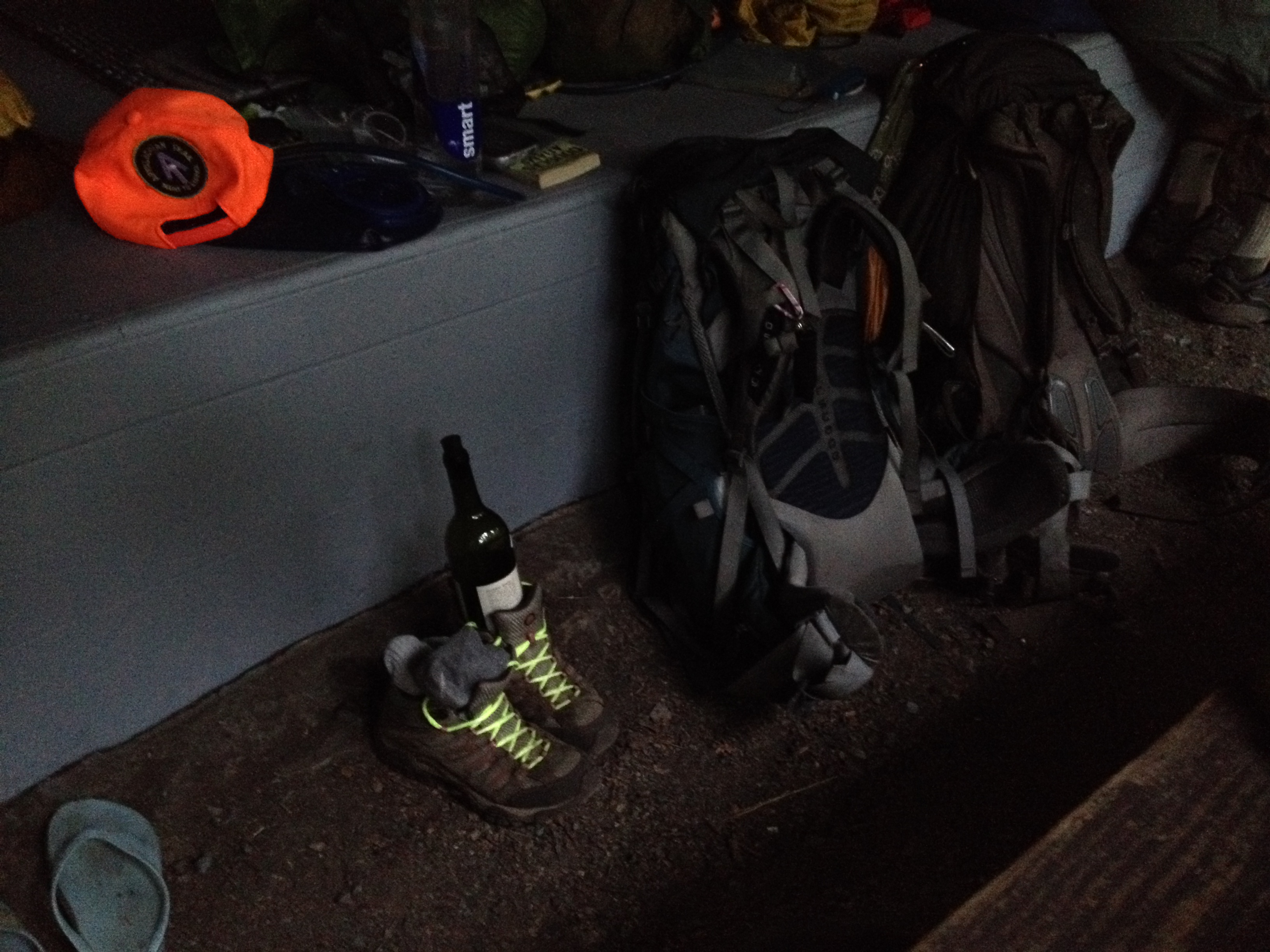
My Salomon GoreTex boots froze on a couple of nights because I had no room for them in my extra skinny light weight sleeping bag.  It wasn’t a big deal.  So long as I had dry socks, my feet were never cold, even in frozen boots.

Sweaty clothes.  Only once did I have to whip off a soaking shirt and replace it at the end of the day.  The polyprop shirts I had wicked dry in a very short time after I stopped hiking.  Usually I just covered my base layer with a couple of loose wind shirts I carry for layers.  Over them, snuggled my down puffy as needed.

I often hiked in a pair of compression tights that I use for running and cross country skiing.  They don’t hold water at all.  Best of all, they provide excellent support for leg muscles and joints.  At the end of the day, slipping my rain pants over them did the trick.  No problem wearing the whole giddy-up to bed.

In an earlier blog, I nominated the ziplock freezer bag to replace the Swiss Army knife as the universal tool.  Subsequently, Tenacious Tape gave its zippered brethren a run for their money. 

Somehow, a mouse got into my pack and ate a hole in the baffle between the lower and upper compartments enroute to building a nest.  My sleeping bag developed a hole on the inside.  Wondered why my tent was full of feathers in the mornings…  A three-seam corner in my tent leaked.  The stuff sack for my tent got a small rip. 

Tenacious Tape (and a little silicon sealer) to the rescue. By NOC I had used nearly a whole role of tape.  I bought two new ones from the outfitter at NOC just to play it safe.  Ladies and gentlemen, this stuff works.  It’s specially formulated to STICK to the light weight nylon used in our equipment.  Keep the AMEX card, I wouldn’t leave home without Tenacious Tape. 

Duct tape.  What’s that?

David “Awol” Miller’s guide is the gold standard.  It’s highly accurate, though not perfect.  I carried the AntiGravity Gear strip maps as a supplement.  Gave up on them quickly. 

The universal challenge with the AWOL Guide is reading the trail profile.  On days the trail looks easy, it’s hard in reality and visa versa.  A lot has to do, not with the trail incline angle, but the surface condition of the trail bed – how rocky, number of steps and boulders, roots, etc.  Just don’t be lulled into a false sense.

A lot of the trail infrastructure listed in the Awol Guide pops up during hiking season; then disappears by the end of April.  That was a tough one to learn.  Shuttlers, hiker rates, and other conveniences haven’t been there in some cases.  Also be advised that those listed in the Guide pay to be there.  (I asked.)  Nothing wrong with that, but caveat emptor. 

Saw evidence of a lot of bear bag hanging disasters in the form of ghostly and mossy derelict food bags tangled way up high. Alternatively, there’s ample evidence of cut ropes decorating prime hanging trees like nylon tinsel.  I’m keeping my fingers crossed.  So far, so good.  Just hang your food, please.

Speaking of food, since I’m cooking exclusively in ziplock bags, I switched my stove from a Pocket Rocket to the small Jet Boil Sol.  It’s incredibly more efficient at boiling water which is all I do.

Lastly, I tented most nights near shelters.  My tent was warmer and easier to keep my “stuff” organized and safe.  Unfortunately, at a shelter in the Smokies, three meals disappeared after I hung my food bag on the bear line.  At the same shelter someone rifled my pack when I was outside cooking and took three twenty dollar bills from deep within. Lesson learned.  I’ve since acquired a wallet that hangs around my neck.  $hit happens. 

On blogging and future plans

20131030-194816.jpg

AT blogs seem to be divisible into two fundamental categories. The travelog and the essay.

The travelog blogs appear to try and chronicle in as much detail each day more or less as the hiker progresses. In 2013 there were several outstanding writers of this genre. My favorite was Linda (Karma) Daly’s blog at http://thumperwalk.com.

The essayists pick topics and explore them. A lot of the travelog detail makes it into these stories, just not in chronological order. Clever Girl was, in my view, handsdown best in this class at http://trailkit.blogspot.com

My blog is a collection of essays. Either my imagination is a failure, or I’m too boring to write a travelog. I’ve spent 36 days hiking the Appalachian Trail since 10:08 a.m. Sept. 24. That’s enough to know that most of the days are pretty much alike. The first time something happens, it’s special. After that it becomes pretty mundane. I can’t make writing about hiking in the rain interesting more than once – if that – unless it turns into an adventure of sorts.

I’m telling you this because I have some readers who may be expecting a travelog. For instance, someone wrote to me correcting my mileage to date. It’s 400.8. What I said in my last blog was that I was writing from Hot Springs, NC. Due to the essay format, I did not say I hiked there. In reality, I got a shuttle from Davenport Gap where I’d stayed at Standing Bear Farm, to Elmer’s Sunnybank Inn in Hot Springs. Hence the missing miles.

I needed the shuttle because my wife was scheduled to pick up me, along with two other hikers who needed to get to the D.C. area, in 36 hours. With sore tendons from having to hike long days to reach certain shelters in the Smokies, I was in no condition to hike 38 miles that quickly. Moreover I was a day behind schedule thanks to the storm that dictated my side trip to Gatlinburg. So, I got a ride and took a zero in a great hiker town to make up the difference.

When I return to the tail, I’ll spend another night at Sanding Bear and start hiking the next morning from Davenport Gap. No way I’m going to miss Max Patch! I’ll also get another night at Elmer’s when I reach Hot Springs. That’s a bonus.

The plan for the hiking through the winter is simple. Since I’m solo, I am acutely aware that I need to be careful of the weather. My wife and I will be paying acute attention to 10-day forecasts with the intention of being off the trail during storms. The accuracy of 10-day forecasting means I’ll be hiking on average from three to seven days out of every 10.

In addition, from this point on, I’ll be trucking my full winter kit complete with snowshoes, microspikes, mittens, balaclava, including down jacket, pants and booties to supplement my sleeping bag. Everything is in dry sacks. The down garments are double bagged.

My winter goal is to reach by the end of March, Waynesboro, VA where I started on Sept. 24. If this is a stormy winter, that may not happen. If not, I’ll dive into the first 2014 hiker bubble that comes along in the spring.

I did hear that there are two men and one woman, each hiking solo, ahead of me. I hope to meet them before the winter is out.

So, family, friends and random readers, that’s the plan. More to come on gizmos and gadgets, the 2:3 ratio, the cost of trips to town, and more.

BFRs. What are they good for?

BFRs. Yup, Big Effing Rocks! What are they good for? In Appalachian Trail maintenance, most everything.

The Hoodlum work crew had another great weekend, our final regular outing until March.

The work group to which I was assigned built two check dams and a water bar on the Pass Mountain trail – a blue blaze trail in Shenandoah National Park.

This video offers a little bit of insight into the work we do and the fun we have doing the work and afterwards.

The water bar we are constructing in the video was much needed to help keep the trail in good hiking condition.

Hikers sometimes wish the trail was in better condition with fewer rocks and less erosion. Rest assured there are a ton of volunteers up and down the full length of the AT working had to keep it in the best condition possible.

If you think the rocks are bad now, imagine the AT without erosion control and other maintenance.

All erosion control structures require building material. Stone is best, but simple swales only require mounds of dirt. Logs, particularly extra hard woods such as Ash are long lasting substitutes when stone isn’t available.

If stone is preferred. Than BFRs are the best you can get.

Rock potentially lasts a lifetime. Moreover, if the stones used are ginormous enough and set deep into the trail tread, the bears have a hard time digging them up to get at the grubs that take up residence underneath. Yup, the bears love to play three card Monte with big rocks. Sometimes they even score a treat.

Chunking BFRs around is hard work with dependent mostly on brute force and ignorance. You really only need one smart person who knows where the rocks should go for best effect. That means I’m pretty much qualified be a rock technician, but not for the engineering jobs.

Erosion control structures on the AT come in a simple variety. Check dams are perpendicular to the trail with the purpose of slowing down the water flow. They should stick up a few inches and require frequently cleaning to ensure sediment doesn’t render them useless.

Water bars are set at a 45 degree angle to the trail direction. Their purpose is to direct water off the trail. Check dams and water bars frequently work in coordination with one another

Parallel drains are canals/ditches that run parallel to the trail tread for some distance until they reach a point where water can be sent away. Sometimes the trail tread is raised and the canals are made of carefully fitted stone.

Steps help prevent erosion or may simply improve the hiking experience by adding safety or by making the trail easier. Stone is preferable and more durable, but logs and compacted dirt or gravel work.

You’ve all seen the ladders and rebar in New England. Those are special cases.

Sometimes dirt swales are dug and the spoil is mounded and compacted to form a check dam or water bar that works fine as long as it lasts.

If you live close to Shenandoah National Park, consider joining the Potomac Appalachian Trail Club and channel your inner 12-year-old. Become a Hoodlum Trail Crew member. It’s fun!

SOBO is the loneliest number

Image

I met a lot of SOBO (Southbound AT hikers) during my recent two week hike on the Appalachian Trail.  But with the exception of the large Millennial flash mob at Pinefield Hut, they were few and far between.

As I met southbounders along the trail, they were eager to talk and enjoy a little company.  We always exchanged the usual trail intel – water sources, was Shenandoah allowing thru hikers to pass through, trail conditions, etc.  Yet beyond that, they all said theirs was a lonely hike.  They just didn’t see that many people.

It was always best to meet up with SOBOs at shelters.  Then we had the time to enjoy each other’s company.  Usually they were by themselves.  On two occasions, other than the flash mob, there were two or three.  At Gravel Springs I ran into a thoughtful young man on a post high school gap year.  Joining us was a PhD student in cultural geography and his Spanish girlfriend from Madrid. 

On that evening and again at breakfast, we had stimulating discussions about books we’d read in common, what America was like in comparison to expectations, and we exchanged a few quips in Spanish.  BTW, the American standout was the abundance and types of wildlife.  Think real black bears in the wild – no bars, no barriers, no zoo.  Very cool to a European.

Mostly I encountered about one SOBO per day, usually a day apart from one another.  I’d always tell them who was ahead of them and how far.  A couple of them said they were trying to catch up with people.  The encounters with hikers whose blogs I’ve followed was especially sweet. 

Southbounders have a certain advantage.  Weather tends to be better, especially once they’re out of New England.  They get to avoid most of the heat, insects and the worst of the cold weather. The shelters and hostels aren’t crowed either.

There’s one thing nobody figured on.  Everybody said the trail magic ended as soon as the last NOBO bubble past them by.  It was like nobody cared anymore.  They were alone.  SOBO and solo.  I was saddened.  They were missing the best parts of the AT experience. 

Sisu – Making tracks.

The Benefit of Fitness

Image

Thirty-seven lbs. in a 40 liter pack – ugh!


Visions of history’s great force marches gnawed at my mind as I set out on my last training hike. This hike was deliberately designed to test my limits. 

I constantly reminded myself that my efforts and challenges were a cakewalk in comparison to the distances both armies frequently marched during the Civil War on some of the very ground upon which I was walking. 

The suffering and horror of Bataan or Napoleon’s retreat from Russia were beyond imagination or reasonable comparison.

In this context, my hike was easy.  Why, I pondered, do so many people physically succumb and drop out of their thru hike attempts?  I learned some about why that happens and would like to share it with you.

The test I created was a simple worse case scenario.  I would hike 160 miles in two weeks carrying my full winter kit and 14 days worth of food.  While knowing resupply was easy, I chose to be self-contained and heavy on purpose, just to learn how my body would handle the stress of the extra weight.

In the beginning by total pack weight was 37 lbs.  That wasn’t a monkey on my back, it was a full grown gorilla!  Jane Goodall would have been proud.  As I ate the weight down I expected some relief, but Mother Nature had other malevolent ideas. 

I ate weight, but Momma Nature countered by turning up the heat.  As I basted in my own sweat, my mind played games with my head.  I obsessed about and deeply resented the useless weight imposed by my winter base layer, the 20 degree  sleeping bag and the now useless puffy down jacket.  My clothing bag came to weigh as much as a black smith’s anvil.  Thank heaven there were no hiker boxes around tempting me to off-load a little superfluous mass.

As it was, I pushed to finish one day early in order to beat a tropical storm.  Doing that involved three consecutive 15s and one 20-mile day in 88 – 90 degree temps. Good training for summer weather I thought – fortunately minus most of the blood sucking insects.

The good news is that the time spent pushing myself to near nausea in the weight room with my trainers at Fitness Together paid off in spades. 

This hike was harder than imagined, but thanks to my weight training and running, strength and endurance were never issues.  In fact, I was able to keep pushing hard at the end of several painful and frustrating days.

Age-imposed limitations are the bad news.  After it was over, three full days elapsed before I could even contemplate resuming hiking.  The message there is that I essentially gained nothing by force marching for 13 days.  Zero mileage days actually gain time in the future. 

Today, one week after finishing, my knees are still sore.  The extra weight in my pack conspired with rocky downhill slopes to impose maximum stress on them.  Trekking poles helped some, but not enough.  I vowed that my total pack weight will never exceed 25 lbs. again, no matter what, when or why.

As the hike wore on, small aches and pains asserted themselves.  My calves wanted to cramp no matter how much I drank.  A muscle in the middle of my back decided to go on strike.  My triceps got sore from pushing and lifting myself up with my poles.  My glutes staged 60s-style protests.  I developed a stiff neck from sleeping the wrong way.  Joy was everywhere.

The object lesson is that a zero (rest day) about every fifth day would be optimal.  Zeroing at least once every seven days is mandatory for me.  Otherwise, my body will start rapidly breaking down.  Good to know now while there is still time to plan before the main event begins.

Without the extra fitness level, I would have been screwed. It is good to know, however, that I am able to push as hard, far and fast as necessary if need be.  It’s not too late for anyone hiking in 2014 to get in better shape.  Training hikes help, but weight training, boot camp fitness or cross fit under the supervision of a coach/personal trainer can impressively improve your odds of success.  Think of it as insurance.

The reason I suggest coaching, if you can afford the investment, is that most folks profit from the expertise they offer and their ability to maximize the benefit of your workouts.  For months mine have been specifically designed for hiking and they paid off.  For example, box jumps with weights are perfect training for high-stepping up stone steps and over ledges or big boulders.

And now some breaking news.  Plans have changed for my next training hike.  Roadrunners often train on the same course upon which they will race to gain familiarity.  I’m hoping this rule of thumb applies to hiking.

On October 25th class of ’14 member Mary “Hey Man!” Manley and I will begin hiking the 165 miles from Springer Mountain, Georgia to Fontana Village, North Carolina.  She’s a recently retired nurse.  We’ll travel at her pace and on her schedule.  After reviewing “Baltimore Jack’s” notes, I think about five days worth of grub is the most I’ll ever need on this stretch. 

Not sure how it will go, but we’ll let you know how two retired folks do and will share what we learn from our individual age, gender and hiker perspectives.  You can follow Mary’s blog on WordPress and Trail Journals.

Sisu – Making tracks.

Stink Bugs + Notebook Odds and Ends

Image

 Avoiding stink bugs at Dick’s Dome Shelter


Some days you get the bears, and some days the bears get you. 

Day nine of my hike was the most difficult.  Hard rocks (Aren’t they all?) punctuated most of the day and I had a lot of miles to log.  A little bit of serendipity want a long way, and on balance, I got is good as I gave.

If you read my blog post on music, you know that I’ve given it a lot of attention.  Three times on day nine, music lifted my spirits and lightened my load. 

The first musical magic was Willy Nelson singing  “A Little Bit of Karma” just as the trail leveled out after a long steep climb.  I muttered a weary thanks to Karma, my 2013 thru hiker friend, for her kindly intervention.  This woman has certain super powers.  Could she be a saint, I wondered?  Then, just as soon as the song finished, the trail turned upward again. 

Not much later, John Denver crooned “Country Roads” just as the blue hills of West Virginia hung on the horizon.  I sang along. After all, West Virginia was destination and it would be “almost heaven” when I got there.

Better yet, a couple of hours later, as I worked my way up Pass Mountain with twilight close behind, Hanna Montana uplifted my stride with “The Climb.”  Music saved the day.

Needless to say, after day nine, my feet ached, but not as much as they might have.  My podiatrist made me special orthotics to protect against plantar fasciitis.  They are worth the investment.  They did need an adjustment to widen the heel cup on the left one.  Once it’s back from the lab, I’ll be back agitating AT gravel. 

The first thing I heard a southbounder complained about was stink bugs.  This surprised me because I didn’t recall anyone complaining about them on Trail Journals.  The further north I got, the more prevalent these nosy pests became. 

When I reached the Tom Floyd shelter at mid day, hundreds of them had taken up residence.  A day later I set my tent up inside Dick’s Dome so I could get a peaceful night’s sleep.  Precautions aside, a couple of dead ones fell out of my pack as I emptied it back home.  I’ve got a bad feeling about these guys fellow fourteeners.

Electronics and storage batteries became a challenge.  My 10.5 amp hour storage battery failed for the second time.  I had to heavily ration my phone and iPod batteries.  I did get to charge them at waysides and Bear’s Den.  However, I wasn’t able to blog or take many photos with my phone, or listen to my iPod except for an hour or two at night. I’m working on the fix.

Phone battery hell.  Temps around 40 on the first few mornings played hell with my phone battery, cutting the charge from 50 percent to zero.  I was surprised at this level of sensitivity to cold.  All I had to do was warm it back up, but figuring out how to keep it next to my body in the much colder temps next spring is a must.  Batteries like to be comfortable.

Last, my wife and I developed a system for staying in touch, not knowing how reliable phone service or email might be.  At each opportunity I texted her the AWOL guide NOBO mileage number as I passed landmarks and had phone service.  A simple 968.3 was easier to get through on one bar than something more complicated.  While I couldn’t always text my final daily location, we never went more that 12 hours being out of touch.

Rock Taxonomy

Image

Tennessee Tripping Stone.


It’s ironic that, in comparison to one another, the Rocky Mountains aren’t and the Appalachians are. 

Put more directly, if the only rocks on the Appalachian Trail that hurt your feet were limited to Pennsylvania, then hiking the AT would be a piece of cake.  Unfortunately, ugly boot-eating rocks are everywhere throughout the length of the AT.  Even if you could run from them, you couldn’t hide.

On my recent 160-mile training hike, the southbounders regaled me with stories about under estimating Connecticut while bitching about New York, New Jersey and Maryland rocks, all  in the same breath.  Don’t even start them on New Hampshire and Maine.  Pennsylvania?  They described it as “average!”  Vermont seemed to be the only exception, but what kind of trade off is mud?

Late on day eight, a particularly rocky stretch on the steep down hill from Mary’s Rock (best view of the Shenandoah Valley) was eating my feet for lunch.  The trail was seriously rocky and my feet hurt like hell.  I still had four miles to go.

In the low angle light of the setting sun I glanced at my hiking poles and noticed a string of spider webs streaming from them like Tibetan prayer flags.  That would be serendipitous I thought. If my poles only had prayer wheels, I just might make it.  That’s when I began thinking about classifying the different kinds of rocks under my feet.

Rocks aren’t just rocks.  Each has a job and role to play as part of the trail.  The more benevolent among them are esthetic.  Usually covered in moss or lichens, they hang out like runway models along the sides of the tread.  Others tumble down talus fields or become giant boulders that frame the scenery.

As for the rest of them, well…  There are generic Pennsylvania grade rocks.  They primarily ensure that the trail surface is as uneven as possible with the idea of slowing down hikers.  Think of the as speed bumps. 

Among the most common are Tennessee Tripping Stones.  These are specially planted snaggle tooth rocks notable for their triangular shape resembling miniature Matterhorns.  They’re found randomly and with a surprising regularity.  When hidden among generic rocks or obscured by leaf litter, it’s easy for them to score stumbles and bruise toes.  The trail has teeth.

One of the least of my favorites are a certain kind of small loose rocks that cause very nasty falls.  When descending down hill, hikers have to put their weight on their lead foot.  If you happen to step on a round rock that acts much like a ball bearing, your downhill foot shoots out from under you, and you assume the telemark position in cross country skiing as your trailing knee dives into the trail.  Since I love compound German words, I made one up for these kind of rocks – kugellager steinen or ball bearing rocks – seems apropos. 

Along the way I found a few Shenandoah Stumbling Blocks.  This glorious style of coffee can-size stones appears randomly in hopes of hobbling, harassing and slowing.  They love to hide in leaf litter.

Then there are universal ankle rollers.  These you never see, but you know what happens. 

My least favorite is the Susquehanna Snot Slicker.  This type of stone is used almost exclusively for stream crossings.  Notable for their teflon-smooth convex surfaces, their dome shaped top ensures that hikers get a minimal grip on them.  Very slippery when dry, they’re slipperier than snot when wet.  Cross at your own risk.

But it doesn’t end there.  Terrible talus and pole benders are abundant too.  Get movin’ too fast when a pole bender traps your walking sticks, and Leki gets to gift you a new end segment ’cause the old one has just taken a 90 degree turn!

There must be more.  I heard about crazy capsizers – loose stones that turn over when you step on them, but I didn’t encounter any. 

BTW, it took my feet two full days to recover from the ride down Mary’s Rock.  Can’t wait to get back out there and make some tracks.  Sisu

Flash Mob at Pinefield Hut

Image

It was a dark and thirsty night, but the old folks at Pinefield Hut didn’t know that yet. 

Meanwhile, day three of my Appalachian Trail training hike had just closed.  In spite of my heavy pack, I’d made good time walking on the contoured terrain around the Loft Mountain camp ground. Put it in the books as a good day.

There I was making camp with a couple of younger guys just out of the Army and an older 70-something thru hiker recently back on the trail following a long injury recovery. He was hiking from his home near Delaware Water Gap to the place in southern Virginia where he had to leave the trail this past spring with his hopes for completion long dashed.

It was dark and quiet with hiker midnight fast approaching.  The military guys decided to tent leaving the shelter to the two older guys.  It would be my second night in a shelter, but given the hour, it didn’t seem like we should be expecting more company.

Wrong!

Just as we were settling in a couple of young Millennials drifted in.  One was a young woman whose blog I’d read and we had a nice conversation about that and other mundane aspects of the trail.  Than a few more young faces drifted in from the darkness – and a few more after that.  The dynamic of one of those You Tube flash mobs quickly took over.

Once the crowd reached critical mass, out came beer, wine in one and two liter bottles.  In a flash the picnic table was groaning under their weight.  I checked my watch.  Ten thirty.  For me, it was past time to sleep.  For them it was party time.

A roaring fire accompanied a solo guitar.  Alcohol fueled voices harmonized – more or less.  The rowdy revelry continued well into the wee hours before dawn.  The other adult hiker and I scrunched into the deep shadowy recesses of the shelter and tried to sleep, me with my iPod cranking out an alternative soundtrack.   

It was a stereotypical display of Millennial self-absorption. I generally hold young folks in high regard having worked with 18 – 24 year-olds most of my life.  This group, other than being inconsiderate, wasn’t that bad with a couple of obnoxious exceptions.  As minor payback I certainly didn’t hesitate to make noise when I broke camp at the onset of morning nautical twilight.

One thing came out of it, a new song to add to my AT playlist.  Judy Collins’ “Send in the Clowns” seems a most appropriate way to memorialize the evening.